
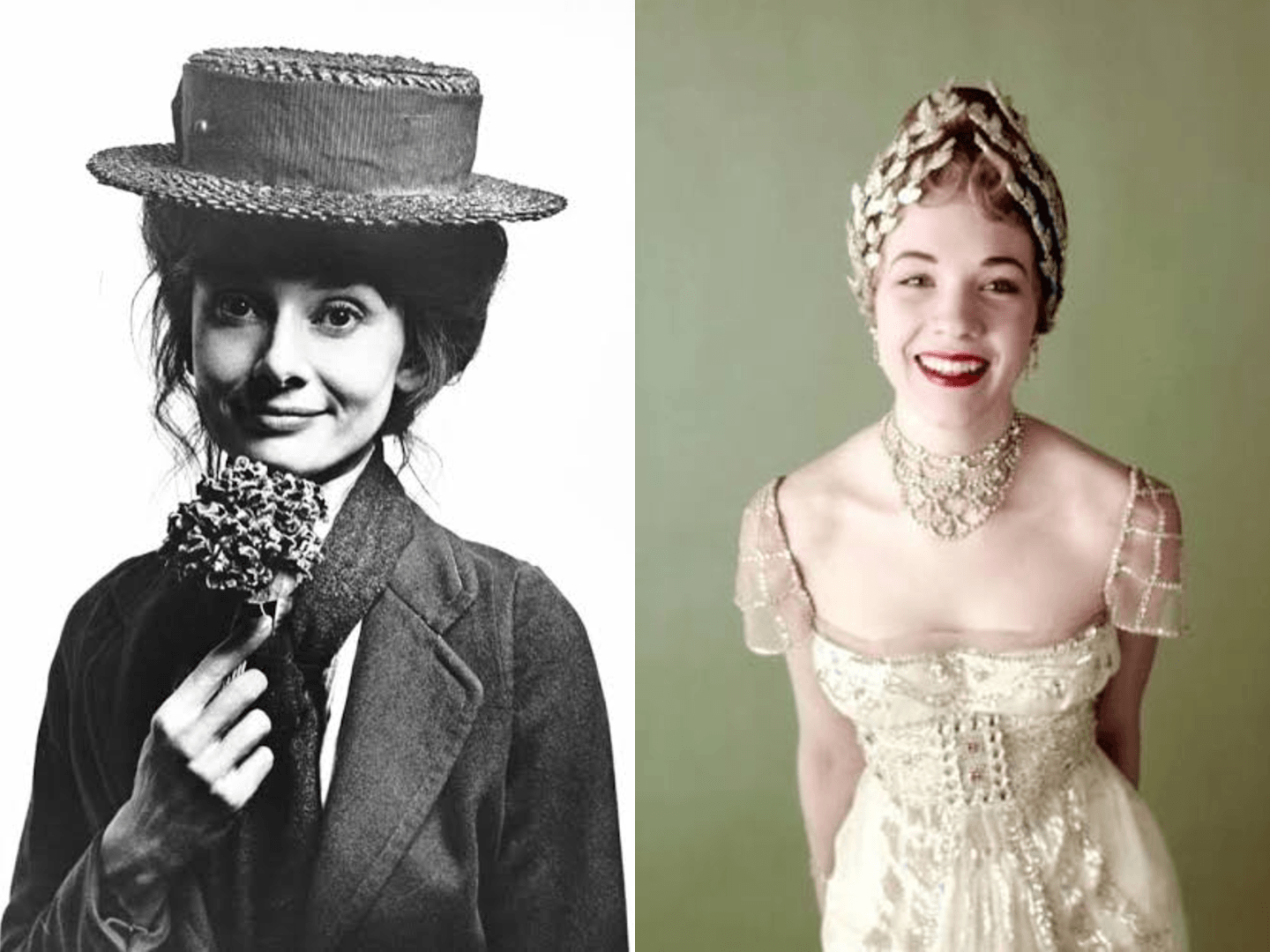
Eliza Doolittle is the Cockney flower girl at the heart of My Fair Lady, the 1956 Broadway musical adapted from George Bernard Shaw’s Pygmalion. She begins as a street vendor who seeks elocution lessons from Professor Henry Higgins and becomes the subject of a wager that he can pass her off as a duchess. Her journey from Covent Garden to the embassy ball remains one of musical theatre’s most enduring character arcs.
Shaw wrote Pygmalion in 1913, and the role of Eliza was originally played by Mrs. Patrick Campbell on the London stage . Shaw conceived the character as a subversion of the Pygmalion myth: instead of marrying her creator, Eliza walks out on Higgins and vows to live independently . That original ending emphasized her self-determination rather than romance.
The musical My Fair Lady, with book and lyrics by Alan Jay Lerner and music by Frederick Loewe, opened on Broadway in 1956 . The production transformed Shaw’s play into a major commercial and critical success, and it made Julie Andrews, then a young British actress, a Broadway star . Andrews trained with a dialect coach to acquire the Cockney accent required for the role .
Andrews originated the stage role of Eliza, but she was famously not cast in the 1964 film adaptation. Producer Jack Warner chose Audrey Hepburn instead, a decision that became one of Hollywood’s most discussed casting controversies . Hepburn’s singing voice in the film was dubbed by Marni Nixon, though Hepburn had campaigned to perform her own vocals . Nixon also dubbed for Natalie Wood in West Side Story and Deborah Kerr in The King and I .Eliza Doolittle Quick Bio
| Field | Information |
|---|---|
| Full Name | Eliza Doolittle |
| Also Known As | Liza; “The Flower Girl” |
| Origin | Lisson Grove, London, England |
| Nationality | English |
| Occupation | Flower girl (before transformation) |
| Created By | George Bernard Shaw |
| First Appearance | Pygmalion (1913 play) |
| Musical Adaptation | My Fair Lady (1956 Broadway musical) |
| Family | Alfred P. Doolittle (father) |
| Spouse | Freddy Eynsford-Hill (in Shaw’s original play) |
| Age | Fictional; casting materials list a range of 18–35 |
| Notable Portrayers | Mrs. Patrick Campbell (1914), Wendy Hiller (1938 film), Julie Andrews (1956 Broadway), Audrey Hepburn (1964 film), Martine McCutcheon (2001 revival), Lauren Ambrose (2018 revival) |
Notes on omitted fields: Height is described only in dialogue (“5ft 6in” per Colonel Pickering’s police description) and is not a verified character attribute . Education, years active, awards, net worth, and social media do not apply to a fictional character created in 1913. Spouse is confirmed as Freddy Eynsford-Hill in Shaw’s play, though the musical’s ending leaves this ambiguous .
The 1964 film, directed by George Cukor, received substantial acclaim. The New York Times critic Bosley Crowther praised Hepburn’s performance, writing that she “superbly justifies the decision of Jack Warner to get her to play the title role” . At the 37th Academy Awards, the Best Actress award went to Andrews for Mary Poppins, while Hepburn was not nominated for My Fair Lady . The coincidence of the two films became a notable moment in Oscar history.
Eliza’s songs remain central to the musical’s identity. The score includes “Wouldn’t It Be Loverly,” “The Rain in Spain,” “I Could Have Danced All Night,” and “Just You Wait” . These numbers trace her emotional evolution from longing and frustration to exhilaration and defiance. The music carries her arc as much as the dialogue does.
Later revivals brought new interpretations of the role. Martine McCutcheon played Eliza in the 2001 London revival and won the Olivier Award for Best Actress in a Musical in 2002 . Lauren Ambrose took the role in the 2018 Lincoln Center Theater revival on Broadway, earning a Tony Award nomination for Best Actress in a Musical . These productions demonstrate how each generation of performers reinterprets Eliza’s blend of vulnerability and resolve.
The character’s legacy extends beyond the stage. The name ELIZA was used by Joseph Weizenbaum for his early artificial intelligence program, a reference to the fictional character . That detail suggests how deeply Eliza Doolittle has entered the cultural vocabulary. She represents transformation, but also the question of who gets to define what a person becomes.
What makes Eliza endure is the tension at the center of her story. She gains polish and polish gains her access, but the musical never fully resolves whether she has been liberated or merely remade to suit Higgins’s vanity. That ambiguity, inherited from Shaw, keeps audiences returning to My Fair Lady and to the flower girl who learned to speak and then learned to speak back.
Who originally played Eliza Doolittle on Broadway?
Julie Andrews originated the role of Eliza Doolittle in the 1956 Broadway production of My Fair Lady . She was cast after the creative team saw her in The Boy Friend . Andrews later starred in the 1964 film Mary Poppins and won the Academy Award for Best Actress that year .
Why didn’t Julie Andrews star in the 1964 film version?
Producer Jack Warner chose Audrey Hepburn for the film, reportedly feeling Andrews was not yet a bankable movie name . Hepburn’s singing was dubbed by Marni Nixon . The New York Times critic Bosley Crowther praised Hepburn’s performance, calling her Eliza “crisp, wondrous and enchanting” .
How does the musical’s ending differ from Shaw’s original play?
Shaw’s Pygmalion ends with Eliza leaving Higgins and asserting her independence. The musical, drawing from the 1938 film version, concludes with Eliza returning and Higgins asking, “Eliza, where the devil are my slippers?” . This romantic ambiguity departs from Shaw’s deliberate refusal to pair them as lovers .
What awards has the role of Eliza earned for its performers?
Martine McCutcheon won the Laurence Olivier Award for Best Actress in a Musical in 2002 for her performance in the West End revival . Lauren Ambrose received a Tony Award nomination for Best Actress in a Musical for the 2018 Broadway revival . These honors reflect the role’s continued prestige across generations.
